Gorgo uses memory techniques that work with your brain. No streaks, no ranking, no infantilizing.
Ok ready?
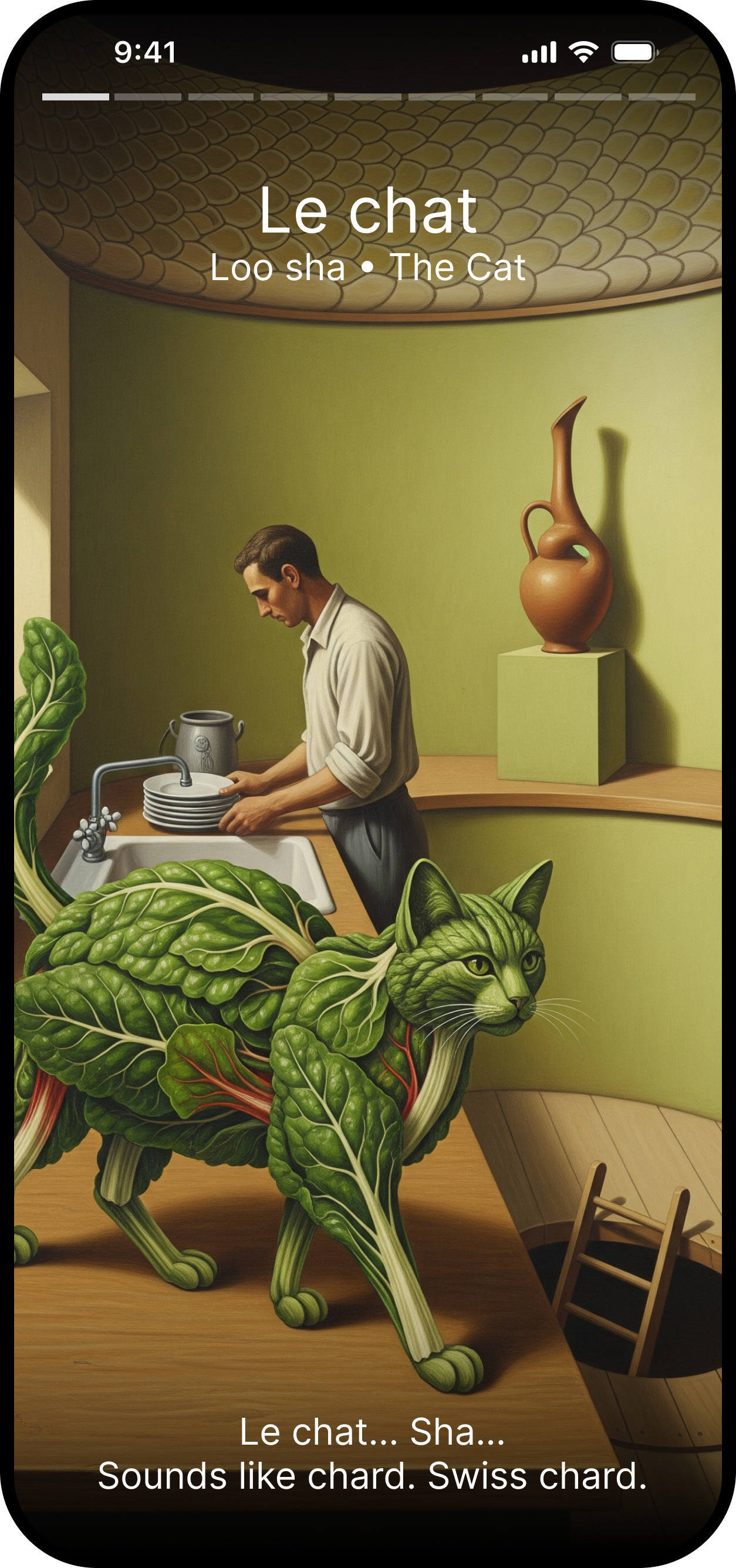
A voice, “Le chat. Loo sha... sha… like chard.”
He continues.
“Chard cat. On the counter. Green leaves. Breathing. Leaves rustle. Smells like vegetables.”
-
You will not forget it.
Gorgo is built around the way the brain actually holds onto things—spatial memory is one of the oldest cognitive systems the brain has.
The technique is called the method of loci, or memory palaces. It's 2,500 years old. In Gorgo, every word lives in a scene. The scenes are in palaces. To remember a word, you visit. The visiting doesn't feel like studying. It feels like noticing things in a place you've been before.
The research is thrilling…
Maguire, E.A. et al., “Routes to remembering: the brains behind superior memory,” Nature Neuroscience (2003); Wagner, I.C. et al., “Memory training for memory athletes,” Neuron (2017); Kubik, V. et al., “The method of loci in the context of psychological research: a systematic review and meta-analysis,” 2024.
Gorgo is starting with French, but the tool was built to scale to many other languages. Those will come eventually.
Mnemonics work for all words, not just A1. Gorgo focused on the most frequent 3000 words.
-

Conduire To Drive
Con-door… Sounds like condor.The man grips the steering wheel. The condor could feel the mans exhaustion, but there was nothing to do but drive.
-

Ombre Shadow
Ohm-bray… Umbrella. Beret.The swimmers float. The felt berets warmed under the sun, casting useless, circular shadows. Not shade, per say. Shadows.
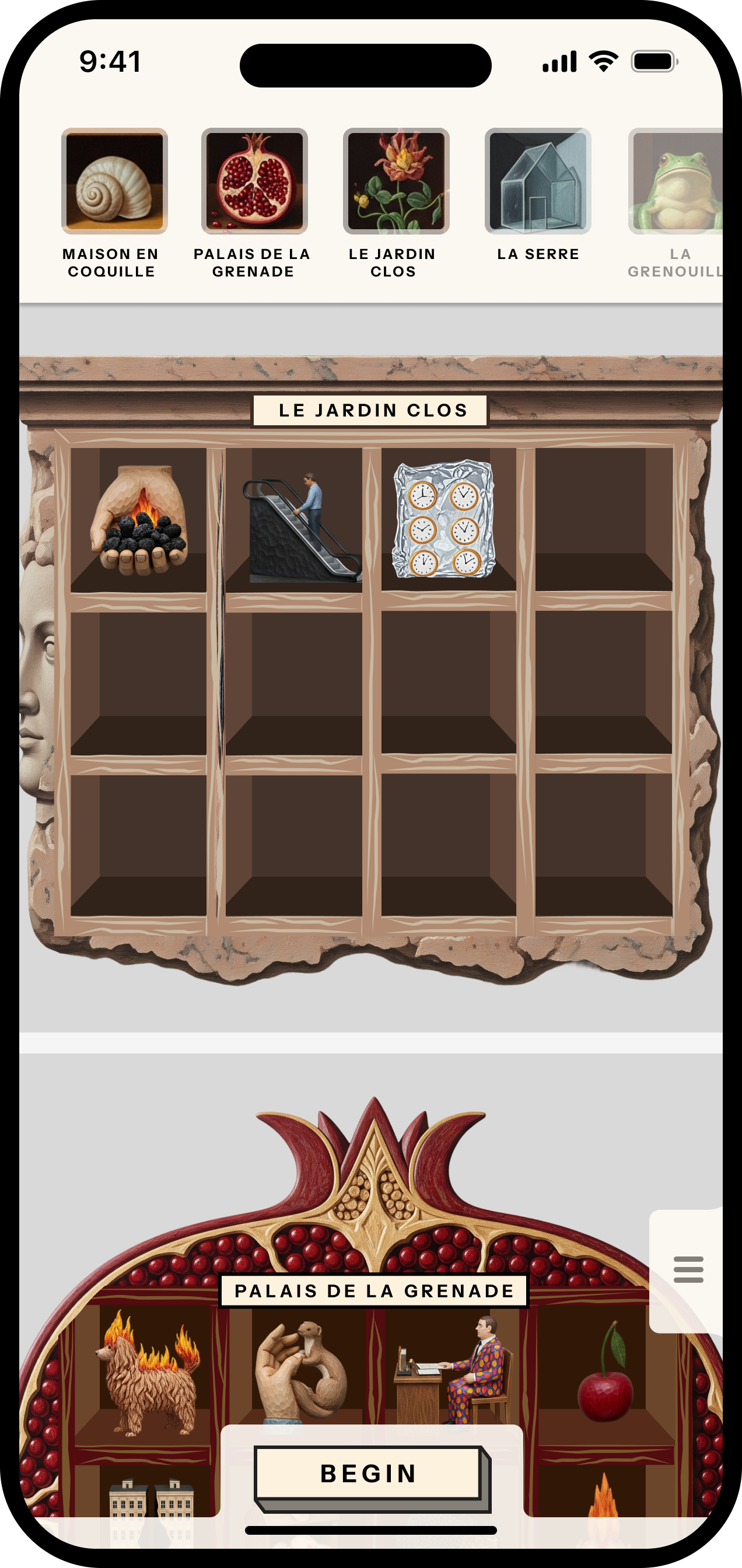
Words become objects.
The shelf fills as you progress through a palace.
Dual coding: Allan Paivio's dual-coding theory holds that information stored along both verbal and imagistic channels is recalled more reliably than information stored along either alone.
The smell of vegetables or the heft of a kitchen counter extends the principle along as many channels as the scene will accept.
Join us in Gorgonia.
We’re looking for early arrivals.